Most players do best somewhere between 7.5 and 8.4 oz, and moving within that range trades maneuverability for pace in small, predictable steps. But the number printed on the paddle — static weight, what it weighs on a scale — isn’t the number you actually feel when you swing it. That’s swing weight, and it’s why two paddles that both say “8.0 oz” can feel completely different in your hand.

Static weight vs swing weight
Static weight is simple: put the paddle on a scale, read the number. It’s the spec every retailer lists, and it’s genuinely useful as a starting filter. But it can’t tell you where that mass sits — and where the mass sits changes everything about how a paddle feels in motion.
Swing weight measures how heavy a paddle feels to swing, technically the mass moment of inertia about a pivot point near your hand. A paddle with more mass toward the tip (“head-heavy”) has a higher swing weight — it resists rotation more, so it feels heavier to move, but it hits with more stability and “plow-through.” A paddle with mass concentrated near the grip (“handle-heavy”) has a lower swing weight — quicker to whip around, easier on fast hands at the kitchen, but less stable on contact. Two paddles can share an identical static weight and still feel nothing alike, because one is built head-heavy and the other handle-heavy.
Manufacturers rarely publish swing weight, but where it is measured, typical values fall around 400–700 oz-in² (roughly 70–130 kg-cm²) when gripped about two inches from the bottom of the handle — with lower numbers feeling quicker and more maneuverable, higher numbers feeling more stable but slower to move. If a listing doesn’t mention it, assume you’re working from static weight and balance descriptions (head-heavy / handle-heavy / balanced) alone.
What the ounces actually feel like
| Weight band | What it feels like | What it helps | What it costs you | Tends to suit |
|---|---|---|---|---|
| Under 7.6 oz | Quick, easy to whip through fast exchanges | Hand speed, quick resets and redirects at the kitchen | Less built-in pop — you supply more of the power yourself | Dink specialists, control-first players, anyone still building arm stamina |
| 7.6–8.0 oz | Balanced — still quick, with a bit more drive behind contact | Control with real pace, the widest all-round comfort zone | Slightly less nimble than the lightest paddles | Most competitive all-court players; a sensible starting point for beginners |
| 8.0–8.4 oz | Noticeably more solid on contact | Adds pace without changing your swing technique | More tiring to swing by the end of a long session | Players who want the paddle to do more of the work; several sources point beginners toward the upper half of this band (around 7.8–8.2 oz) for exactly that reason |
| 8.4 oz and up | Substantial — drives the ball hard with less effort from you | Raw power on drives and put-aways | The most tiring option to swing over two or three full games | Dedicated power players comfortable trading maneuverability for pace |
Bands reflect manufacturer and specialist-source guidance current as of August 2026 — see sources below. Manufacturers set their own band edges, so treat these as a guide, not a hard boundary.
What adds weight after you buy it
You don’t have to get the weight exactly right on day one — small, deliberate additions after purchase can fine-tune both static weight and swing weight.
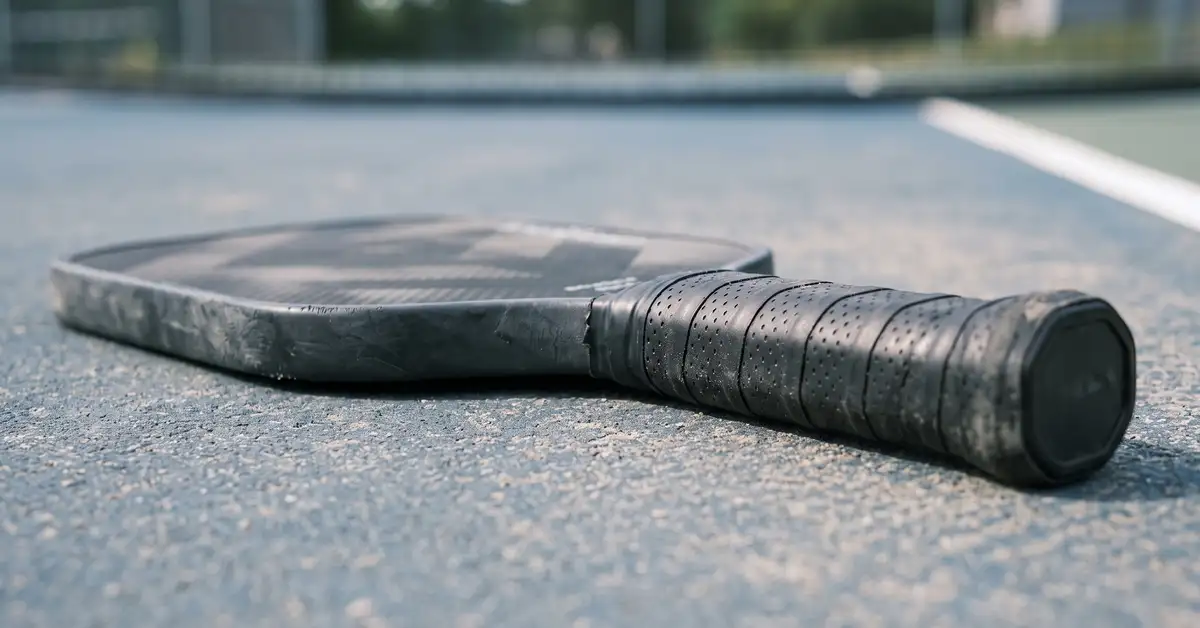
Overgrips add a small amount of mass right at the handle. Because that mass sits close to your hand, an overgrip raises static weight only slightly and has a much smaller effect on swing weight than the same mass added near the tip — in practice, players use overgrips to firm up feel and tackiness more than to meaningfully change how heavy the paddle swings.
Lead or tungsten tape is the more deliberate tool. Quarter-inch lead tape commonly comes in 0.25 g or 0.5 g per inch (the heavier option needs fewer layers for the same added mass); half-inch tape runs 1 g or 2 g per inch. Tungsten tape, sold as a lead alternative, is typically 1 g per inch in long rolls you cut to length. Placed near the tip, a few inches of tape can add a noticeable, repeatable amount of plow-through; placed along the sides, it raises stability on off-center hits with less effect on how heavy the paddle feels end-to-end.
Edge guard tape is usually sold as a protective accessory first, but it isn’t weightless — players have reported roughly 13 g (about 0.46 oz) once wrapped around a full edge. Because that mass sits around the paddle’s perimeter, it tends to add a little extra stability on off-center contact without dramatically changing how the paddle whips through your hand.
Third-game fatigue, honestly
The heavier the paddle and the more head-heavy its balance, the more tiring it tends to feel by your second or third game — that’s simply more mass being accelerated and decelerated, repeatedly, by your arm. A lighter, more handle-biased paddle generally feels fresher for longer. That’s a genuine, useful comfort difference worth weighing against the extra pace a heavier paddle gives you — it isn’t a claim that any particular weight is safer or protects you from anything, and we won’t make that claim. If a paddle feels tiring, the honest fix is trying a lighter one or a different balance, not assuming a specification will solve a physical problem on its own.
How to pick your weight without a shop
If you can’t test paddles in person, a few honest self-checks help more than chasing a precise number. Swing an everyday object of a similar weight — a hardback book or a small skillet — through a few shadow strokes; if it tires your arm within a minute, lean lighter. Think about how you actually play: if you’re mostly at the kitchen making quick touches, maneuverability usually matters more than added pace, so lean toward the lighter half of the mid-weight range. If you’re driving from the baseline and want the paddle to add power, the heavier half suits that better. And remember that feel genuinely varies between players with similar strength and build — the bands above are a sensible starting point, not a guarantee, and a paddle you can adjust later with tape or an overgrip is a safer first purchase than a permanently fixed extreme.
We don’t run a lab and we won’t pretend to. This page is built from manufacturer weight guides, specialist retailer resources, and technical sources that define and measure swing weight — not our own testing. One real, underreported gotcha: several manufacturers publish a weight range for a given model rather than an exact figure, because composite materials vary slightly between units — so the paddle that arrives may sit anywhere within the printed band, not at a single fixed number.
Frequently asked questions
Sources
- Paddletek, “A Beginner’s Guide to Buying the Best Pickleball Paddle” (paddletek.com)
- The Smarter Play, “Pickleball Paddle Weight Guide” (thesmarterplay.com)
- Pickleball Studio, “What Is Swing Weight and Why It Matters in Pickleball” and “The Ultimate Guide to Using Lead Tape” (pickleballstudio.com)
- Pickleball Science, “What do the Swing Weight Numbers Mean?” (pickleballscience.org)
- Pickleball Effect, tungsten weighted tape and paddle accessories listings (pickleballeffect.com / pickleballeffectshop.com)
- Dick’s Sporting Goods, “Pickleball Paddle Buying Guide” (dickssportinggoods.com)
What outranks weight
Weight is one lever among several. If you haven’t settled on a core thickness yet, our 14mm vs 16mm core guide covers the other spec that most changes how a paddle feels — and once you’ve got both dialed in, our best pickleball paddles for beginners guide sorts ten specific options by weight, core, and fit.